
The second purchase is usually won by getting the timing, product and offer right, based on what the customer bought and what they have shown you since.
That sounds obvious, but most post-purchase marketing does not work this way. A customer makes a first purchase, enters a standard flow, receives a few predetermined emails and eventually gets moved into a cross-sell or win-back campaign. The timing is fixed, the products are often predetermined and the offer is usually the same for a large group of customers.
The problem is that the first purchase gives you information that should change all three decisions.
A customer who buys a consumable may be ready to reorder within weeks. Someone who buys a vacuum cleaner may not need another one for a long time, but could have a reason to buy accessories shortly after the first purchase. Whether either customer should receive a discount depends on what they bought, how they bought it and what they do afterward.
The opportunity is to treat the second purchase as a customer-level decision rather than a step in a post-purchase campaign.
Why the second purchase matters?
Acquiring a customer is expensive, which makes the first repeat purchase economically important. The acquisition cost has already been incurred, so getting that customer to buy again allows the brand to generate more value from an existing relationship rather than having to acquire another customer from scratch.
Shopify’s current retention research defines retention in ecommerce largely around bringing first-time customers back to make repeat purchases and recommends tracking metrics such as repeat purchase rate, purchase frequency and customer lifetime value.
Bain’s foundational research on loyalty economics makes the same broader point: customer relationships become more valuable as customers stay longer, partly because the costs of acquisition have already been absorbed and purchasing tends to increase over time. Bain’s research on customer loyalty famously found that a five percentage-point increase in retention could increase profits by 25% to 95%, although the exact impact varies significantly by industry.
The first repeat purchase is therefore more than another order. It is the point at which a first-time customer begins to establish a repeat relationship with the brand.
There is no universal time to the second purchase
The biggest mistake is to assume that every customer should be approached on the same post-purchase schedule.
The right window depends heavily on what the customer bought.
A skincare customer may have a natural replenishment cycle measured in weeks. A customer who buys an appliance may have no reason to buy the same product again for years. That does not mean the appliance customer has no near-term opportunity. It simply means the next opportunity may be a complementary product rather than another purchase in the same category.
Adobe’s ecommerce analytics documentation provides a useful way to think about this. Its repeat-purchase analysis specifically looks at how the probability of another order changes as time passes since the previous order, rather than applying a universal churn threshold. Adobe also recommends looking at the actual time between orders, including the time between the first and second orders, when configuring customer marketing. Adobe’s repeat-purchase analysis makes the underlying principle clear: time since purchase needs to be interpreted in relation to the purchasing behavior of the business.
That means the question is not “Should we send the second-purchase email after 30 days?”
It is “Given what this customer bought, how long has it been, and what are they doing now, is this a good time to create another purchase?”
Your first purchase tells you what to do next
The first order contains far more information than most post-purchase programs use.
The most obvious signal is what the customer bought. Category and product type tell you something about the likely timing of the next purchase as well as what could logically come next.
The purchase also tells you something about price sensitivity. Did the customer buy at full price, or did they need a discount to convert? That does not mean you should automatically offer the same discount again, but it is useful context when deciding how aggressive the next offer should be.
Then there is everything that happens after the purchase. A customer who continues browsing related products, engages with your emails or looks at a particular category is giving you new information about what they might want next. Satisfaction signals, reviews, returns and customer-service interactions can also change the decision.
McKinsey’s research gives some support to the importance of this kind of personalization. In a consumer survey, 78% of respondents said personalized communications and products made them more likely to repurchase. McKinsey’s research on personalization also describes how each interaction can create additional customer data that allows subsequent experiences to become more relevant.
That is why personalization should happen before the email is written. The important decision is not simply what copy to put in front of a customer. It is when to contact them, what to recommend and what kind of offer makes sense.
We explore this distinction in more detail in Email Personalization for Ecommerce.
What most brands do instead
Most post-purchase automation starts with a trigger: the customer bought something.
From there, the brand has a fixed sequence. An order confirmation is followed by education or onboarding, then perhaps a review request, a cross-sell message and eventually a promotional email.
The problem is not the automation itself. Automation is useful when the next action is predictable.
The problem is using the same logic when the next action is not predictable.
A customer who bought a vacuum cleaner at a 20% discount, for example, should not necessarily receive the same follow-up as someone who bought the same product at full price. Their next purchase opportunity may also be different depending on whether they are browsing accessories, looking at other home products or showing no engagement at all.
The flow may execute exactly as designed while still making the wrong decision for the customer.
The second-purchase decision should follow the customer
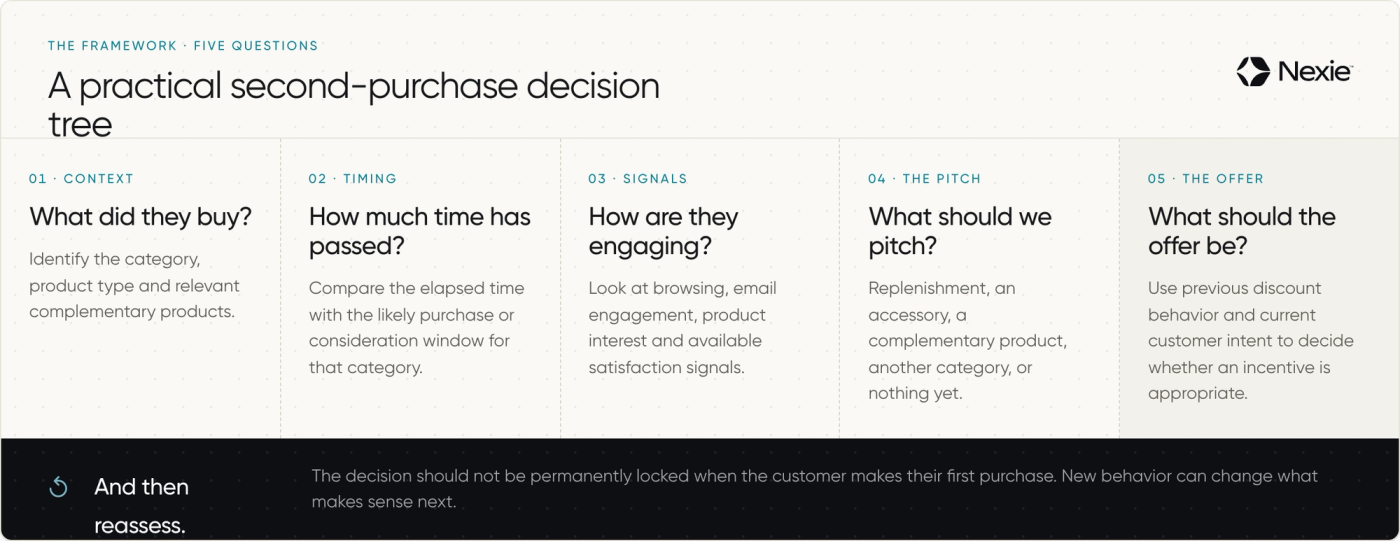
A useful way to structure the decision is as a simple tree.
Start with what category the customer bought. That gives you the context for what a sensible next purchase might look like.
Then look at how much time has passed. Seven days after a purchase can mean something very different from 30 or 90 days, depending on the product.
Then look at engagement. Is the customer browsing? Opening emails? Looking at related products? Showing signs of satisfaction? Or have they gone completely quiet?
Those signals together should determine what you pitch.
Take the vacuum cleaner example. A customer buys a vacuum cleaner at a 20% discount.
Seven days later, an accessories bundle at a similar discount could make sense. The customer already owns the core product, so complementary products are immediately relevant, and the original discount gives you some information about the kind of offer they responded to.
After 30 days, the decision can change. Another vacuum cleaner is still unlikely to make sense, but a complementary home-automation product could be relevant, potentially with a smaller incentive.
If the customer is actively browsing that category, the recommendation becomes stronger. If they have shown no engagement at all, repeatedly pushing products may not be the right move.
The specific products, timeframes and discounts will vary by business. The underlying logic does not: category, time elapsed and engagement should work together to determine the next action.
The offer should depend on the customer too
Timing and product selection get most of the attention, but the offer itself should also be treated as a decision.
A first-time customer who used a discount has already told you something about their willingness to purchase at that price. A customer who paid full price and continues to show strong interest may not need an incentive at all.
The mistake is making discounting the default response to a first-time buyer.
An offer should give the customer a reason to return, but it should not simply give away margin that was unnecessary to generate the purchase.
The first order and the behavior that follows it give you a better basis for making that decision. Previous discount usage, purchase value, product category and current engagement can all help determine whether an incentive is appropriate and, if it is, how aggressive it should be.
What AI changes
A marketer can build separate flows for different product categories, create different purchase windows and introduce rules for different levels of engagement.
The problem comes when those rules have to account for thousands of products, customers and constantly changing behaviors.
At that point, the number of possible combinations becomes difficult to manage manually.
AI can continuously evaluate those signals at the individual customer level. Instead of waiting for someone to reach a predefined stage in a post-purchase flow, the system can reassess what the customer bought, how much time has passed, what they have engaged with since and what their previous behavior suggests about the next offer.
The important change is not simply that AI can generate more personalized email copy. It can make the decision underneath the email more personalized.
The message might still be an email, but the decision about when to send it, what product to recommend and whether to attach a discount can change from customer to customer.
This is part of the broader shift from fixed campaign automation toward continuous customer-level retention, where the system continually understands, acts, measures and adjusts based on new customer information. We explore that model in What Agentic E-Commerce Retention Looks Like.
A practical second-purchase decision tree
The second purchase should not be treated as follow-up
Brands naturally spend a lot of attention on acquisition because it is the point where a prospect becomes a customer.
But the first order is not the end of the acquisition journey. It is the beginning of the retention problem.
The second purchase is where the brand gets its first real opportunity to establish repeat behavior. Getting that purchase requires more than putting every new customer into the same post-purchase sequence.
It requires understanding what the customer bought, recognizing when they are likely to be ready for something else, paying attention to what they have shown you since, and using that information to decide what to offer.
AI does not change the underlying principle. It changes how continuously and how granularly you can apply it.
The goal is not to send a better post-purchase flow. It is to make a better decision about what each first-time buyer should see next.
Nexie is a retention marketing agent for e-commerce brands. It reads your customer data across engagement, recency, category interest and lifetime value together, surfaces the audiences worth campaigning to, and builds those campaigns for your team to review and approve, inside the guardrails and marketing policies you set. See your segments →