
Most ecommerce marketing is organized around what the brand wants to promote. A new product launches, a sale goes live, or a seasonal campaign needs to be sent. The marketing team creates an email, selects an audience, and schedules it.
But customers are at very different points in their relationship with the brand.
Someone discovering your store for the first time needs a different message from someone considering their first purchase. A customer who has bought once needs something different from a regular buyer. And a loyal customer who has suddenly stopped purchasing may need an entirely different approach.
Ecommerce lifecycle marketing helps brands recognize these differences and adapt their marketing to where each customer is in their relationship with the store.
The challenge is that customers don’t move through a neat, predictable sequence. They browse, purchase, explore new categories, become inactive, and sometimes return months later.
An effective lifecycle marketing strategy therefore needs to consider two things: the customer’s lifecycle stage and what they are doing right now.
What is ecommerce lifecycle marketing?
Ecommerce lifecycle marketing is the practice of adapting marketing communications and offers based on where a customer is in their relationship with an online store.
Instead of treating everyone on the customer list the same way, lifecycle marketing recognizes important milestones and changes in customer behavior.
For example, a subscriber who has never purchased might receive product recommendations, buying guidance, and customer reviews to help them make their first purchase.
Once they buy, the objective changes. They may now benefit from product usage tips, complementary recommendations, or a replenishment reminder when the time is right.
If they become a regular buyer, marketing can focus on introducing relevant new products, maintaining the relationship, and rewarding loyalty.
And if their purchase activity begins declining, the brand can try to understand why and find an appropriate way to re-engage them.
This is the difference between organizing marketing primarily around a campaign calendar and organizing it around the customer relationship.
Lifecycle marketing is broader than email. It can involve paid advertising, SMS, onsite personalization, and loyalty programs. However, email is particularly valuable for ecommerce because it can use purchase history, product interest, and customer behavior to maintain communication throughout the relationship.
The 6 stages of the ecommerce customer lifecycle
There isn’t one universal lifecycle model that works for every ecommerce business. But most stores can organize their customers into six useful stages.
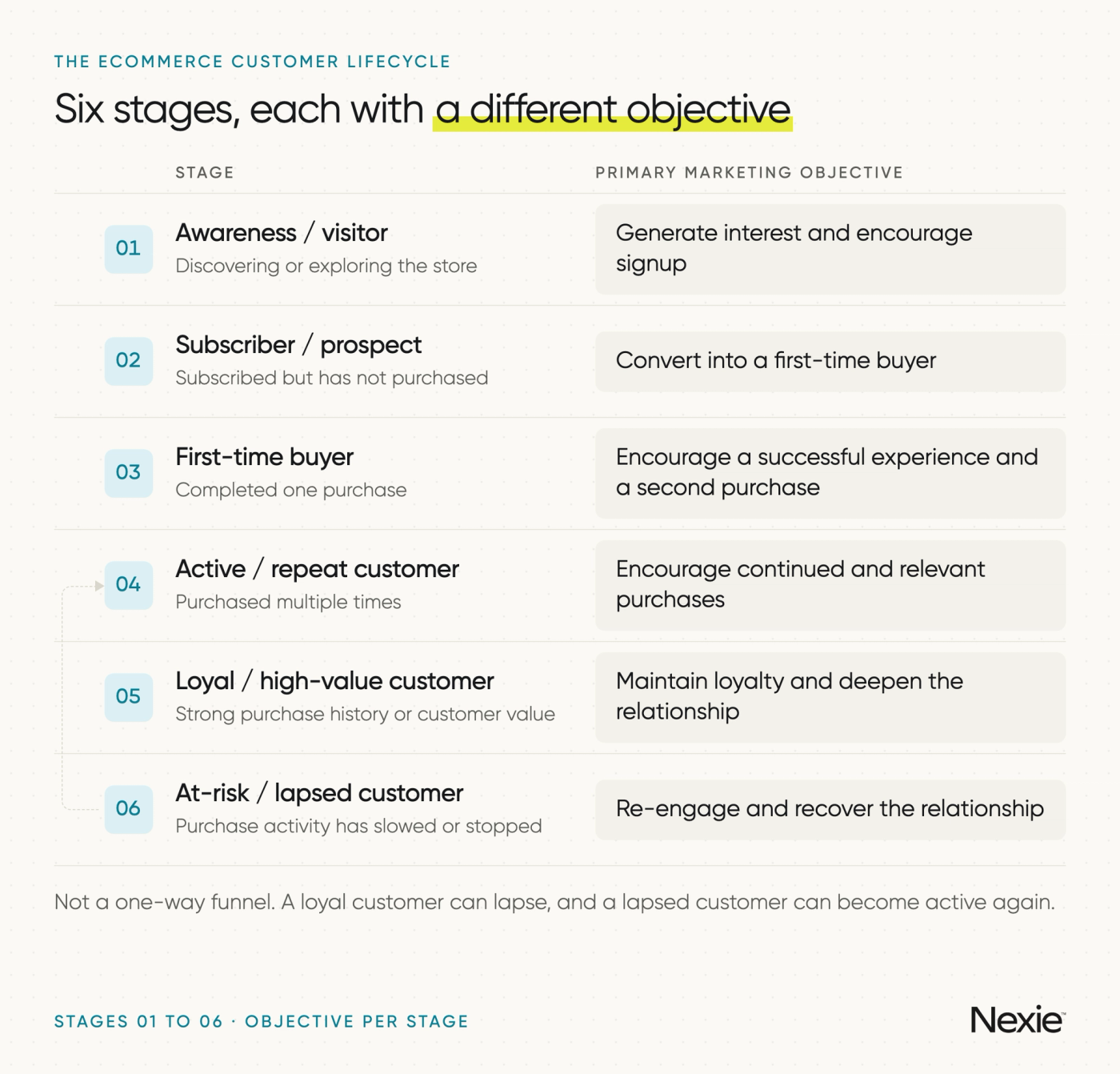
These stages help marketers understand what they should be trying to accomplish for different customers.
But they shouldn’t be treated as a rigid funnel.
A loyal customer can become inactive. A previously lapsed buyer can return and become active again. Someone who regularly purchases one product category might behave like a new customer when exploring an unfamiliar category.
In practice, brands should treat lifecycle stages as useful descriptions of customer relationships, rather than permanent labels.
What marketing should do at each lifecycle stage
Each stage comes with a different marketing objective, and the campaigns, email flows, and offers you use should reflect it.
1. Awareness: turn visitors into identifiable prospects
At the awareness stage, someone is discovering your brand, exploring your products, or learning about the problems your products solve. They may arrive through social media, search, advertising, or a recommendation. In many cases, you don’t yet know who they are.
The first objective is to create enough interest and trust that they want to establish a relationship with your brand.
Useful tactics include relevant signup forms, product guides, quizzes, back-in-stock subscriptions, and first-order incentives where appropriate.
For example, a skincare brand could offer a short routine finder that helps visitors identify products for their skin type. Along with collecting an email address, the brand can learn which product concerns interest the subscriber, provided the shopper chooses to share that information.
This gives the brand a much better starting point for future communication than simply collecting an email address.
2. Subscriber / prospect: help customers make their first purchase
Once someone subscribes, the relationship changes. You have a way to communicate with them, but they haven’t purchased yet.
The main objective is to help them make that first purchase.
Welcome emails are an important starting point, but they shouldn’t be the only communication that helps a subscriber convert.
Depending on what the customer is doing, useful emails might include product discovery, buying guides, customer reviews, educational content, personalized recommendations, and cart recovery.
Consider two new subscribers to a footwear brand:
- One has repeatedly viewed a particular pair of running shoes. They may benefit from information about fit, performance, and customer experiences with that product.
- The other subscribed without browsing much of the catalogue. They may need an introduction to the brand’s main collections before they can decide what to buy.
Both customers are prospects, but their next emails should serve different needs.
The objective remains the same: earn the first purchase. The approach depends on the customer’s interests and behavior.
3. First-time buyer: turn the first purchase into a second
A customer’s first order is an important lifecycle milestone.
They have moved from considering your brand to trusting it enough to buy, although a single purchase doesn’t necessarily mean you’ve established a lasting relationship.
The next objective is to encourage a successful product experience and create a relevant reason to purchase again.
This might involve post-purchase education, product usage tips, review requests, replenishment reminders, complementary recommendations, or introductions to other categories.
For example:
- Someone who buys a coffee machine may benefit from setup instructions shortly after delivery, followed later by relevant recommendations for coffee beans or accessories.
- Someone who buys a replenishable skincare product might receive instructions on how to use it, followed by a reorder reminder around the time they are likely to need more.
The timing and content should depend on what was purchased.
The transition from first purchase to second purchase deserves special attention because it helps establish whether the customer relationship will continue beyond the original transaction.
4. Active / repeat customer: keep the relationship relevant
Once customers have purchased multiple times, the brand has a lot more information about their preferences.
You can learn which categories they favor, how often they buy, what their typical order value looks like, and whether they tend to purchase during promotions.
That information can guide more relevant communication.
- A customer who purchases the same consumable product every six weeks may respond well to timely replenishment reminders.
- Another customer who buys apparel from several categories may be more interested in new arrivals and product recommendations.
Repeat customers can receive relevant product launches, educational content, recommendations, promotions, and loyalty communications.
The objective is to keep giving them relevant reasons to engage with the brand and purchase again.
5. Loyal / high-value customer: recognize and strengthen the relationship
Loyal customers have already demonstrated a strong relationship with the brand. They may purchase frequently, spend considerably more than average, or have remained active for a long time.
Marketing for these customers should reflect the value of that relationship.
Early access to product launches, exclusive products, loyalty benefits, referral opportunities, and personalized recommendations can all be appropriate.
For example, a fashion brand might give loyal customers early access to a collection in a category they purchase regularly.
However, it’s also important to understand that being a high-value customer doesn’t automatically mean someone should receive more emails or bigger discounts. If a customer already buys regularly without incentives, unnecessary promotions may simply reduce margin.
The objective is to maintain the relationship, recognize loyalty, and provide experiences that encourage customers to keep choosing the brand.
6. At-risk / lapsed customer: recognize when the relationship is weakening
Customers don’t all become inactive at the same rate.
A skincare customer who normally purchases every 45 days may be showing signs of disengagement after 70 days without an order. For someone who purchases furniture once every few years, 70 days without a purchase means very little.
That’s why defining every customer as lapsed after a fixed number of days can be misleading. Brands should consider the customer’s normal purchase frequency, products purchased, previous engagement, and changes in shopping behavior.
The right marketing response can also vary.
Some customers may need a replenishment reminder while others may respond to a relevant new product, a different category, or an offer.
And for customers who have shown no meaningful interest for an extended period, reducing communication may be more appropriate than continuing to send repeated discounts.
The objective is to recognize when the relationship is weakening and determine whether there is a useful opportunity to bring the customer back.
Lifecycle stage tells you the objective. Customer behavior tells you what exactly to do.
Lifecycle stages are valuable because they help marketers organize customers around meaningful business objectives.
But the stage alone doesn’t tell you which email a customer should receive.
Consider three repeat customers of the same ecommerce brand:
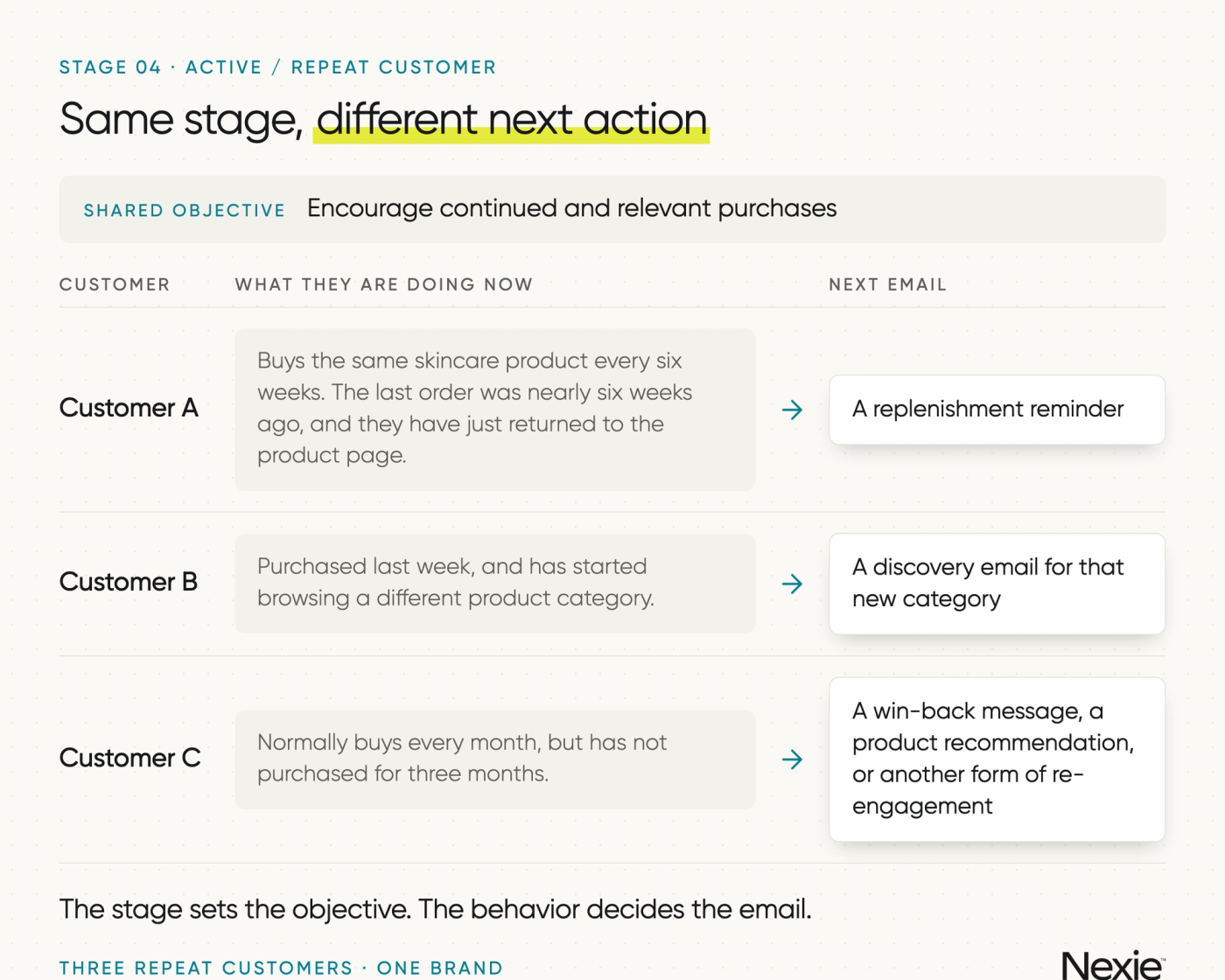
All three are repeat customers, but they represent three completely different marketing opportunities.
The same applies to first-time buyers:
- Someone who bought a replenishable product may be approaching their next purchase.
- Someone who bought a gift might not need the same item again but could be interested in another category.
This illustrates an important distinction:
Lifecycle stage determines the broader marketing objective. Customer behavior helps determine the next marketing action.
For a first-time buyer, the objective might be to encourage a second purchase. But the most appropriate way to achieve that could be education, replenishment, product discovery, or a complementary recommendation.
That decision should consider what the customer bought, what they’re doing now, and how they’ve responded to previous communication.
An effective lifecycle program should therefore be able to choose the most relevant marketing approach within each stage, rather than giving everyone in that stage the same sequence of emails.
How to implement ecommerce lifecycle marketing
To put lifecycle marketing into practice, you need three things: customer segments that identify lifecycle stages, automated flows that respond to customer events, and targeted campaigns that reach relevant audiences.
Most ecommerce brands can build these using their store data and the segmentation, automation, and campaign features in their email service provider (ESP).
1. Create customer segments for your lifecycle stages
Start by connecting your ecommerce store to your ESP and checking that the relevant customer and order data is available.
At a minimum, you’ll need customer profiles, marketing subscription status, order history, purchased products, and purchase dates. For more personalized communication, you’ll also want product browsing, cart activity, email engagement, and previously received campaigns.
With that data, create dynamic segments that identify customers at different lifecycle stages.
For example:
| Lifecycle segment | Example segment definition |
|---|---|
| Subscribers / prospects | Subscribed to marketing and completed zero purchases |
| First-time buyers | Completed exactly one purchase |
| Repeat buyers | Completed two or more purchases |
| Loyal / high-value buyers | Meets a defined lifetime-spend, order-frequency, or loyalty threshold |
| At-risk customers | Previously purchased but hasn’t reordered within the expected timeframe |
| Lapsed customers | Purchase inactivity exceeds a longer, category-appropriate threshold |
The specific definitions depend on the business.
For example:
- An at-risk segment for a skincare brand may include customers who haven’t reordered a product within 60 days.
- A furniture retailer would need a very different definition.
These segments should update automatically as customer data changes. When someone completes their first purchase, they should leave the prospect segment and enter the first-time buyer segment. After their second purchase, they become a repeat buyer.
Some labels may overlap. A loyal customer can also be at risk, for example. You can maintain a primary lifecycle stage alongside additional behavioral or value-based segments.
Beyond these primary segments, create useful targeting groups such as customers interested in skincare, frequent discount buyers, customers approaching replenishment, or repeat buyers who have started browsing a new category.
The lifecycle segments establish where customers are, while the additional segments help determine which communication is relevant to them.
2. Set up automated flows for important lifecycle events
Automated flows send emails when a customer takes an action, reaches a milestone, or meets a defined condition.
Most ESPs connected to ecommerce platforms such as Shopify provide standard triggers for common events, including subscribing, placing an order, and abandoning a checkout. More advanced or store-specific automations can use custom conditions and customer segments.
Here are the principal flows to configure.
| Lifecycle stage | Automated flow | Trigger or entry condition |
|---|---|---|
| Subscriber / prospect | Welcome series | Customer subscribes to marketing or joins the welcome list |
| Subscriber / prospect | Browse abandonment | Identified customer views a product but doesn’t purchase within the configured period |
| Subscriber / prospect | Cart or checkout recovery | Customer abandons a cart or checkout |
| First-time buyer | First-purchase post-purchase series | First qualifying order is placed, paid, or fulfilled, depending on the message |
| First-time buyer | Product education / review request | Relevant purchase or delivery event, followed by an appropriate delay |
| Repeat buyer | Replenishment reminder | Expected reorder date approaches for a previously purchased product |
| Repeat buyer | Complementary product follow-up | Purchase of a product or category that has a relevant follow-up recommendation |
| Loyal / high-value buyer | VIP welcome or loyalty milestone | Customer enters a VIP segment or reaches a loyalty threshold |
| At-risk / lapsed buyer | Re-engagement / win-back | Customer enters an at-risk segment or reaches an inactivity threshold |
The awareness stage is handled differently. An anonymous visitor usually needs to subscribe or otherwise become identifiable before they can enter a customer-specific email flow. Browse abandonment also behaves differently from cart abandonment, even though both sit at the same stage.
Use standard event triggers when they already capture the action you need.
- A welcome flow can start when someone subscribes to marketing.
- A post-purchase flow can start from an order event, with a condition that the customer has completed their first purchase.
This is usually simpler than creating a separate segment just to detect an action your ESP already tracks.
Use segment-based triggers when the condition involves multiple customer attributes or a change in lifecycle status.
Suppose you want to re-engage customers who previously bought skincare products, haven’t reordered within their usual buying interval, and haven’t purchased a replacement product.
A basic “no purchase in 60 days” trigger may not be specific enough.
Instead, create a dynamic segment using the appropriate purchase history and timing rules. If your ESP supports segment-entry automations, you can trigger a win-back flow when a customer newly qualifies for that segment.
The same approach can work for loyalty milestones, high-value customer status, or other conditions that aren’t represented by a single standard event.
Example: triggering a first-purchase flow
A skincare brand wants customers to receive product education after their first order.
One implementation is:
- Use the Order Created or Order Paid event as the trigger.
- Add a condition that the customer has completed exactly one qualifying order.
- Wait until the product is delivered, or use an appropriate delay when delivery tracking is unavailable.
- Send an email explaining how to use the purchased product.
- Follow with a review request or relevant complementary recommendation.
- Stop or skip messages that are no longer appropriate if the customer purchases again.
Alternatively, the brand could create a first-time purchaser segment with an order count of exactly one and use entry into that segment to begin a flow, where supported.
The difference matters.
An order-triggered flow is generally preferable when the email needs details from the specific order, such as purchased products. A segment-triggered flow is useful when the objective is to respond to a change in customer status.
Also remember that someone leaves the “exactly one purchase” segment after their second purchase. If the post-purchase series should continue regardless, use an order-based trigger or configure the segment-triggered flow’s exit behavior accordingly.
Segment membership does not always update at exactly the same moment as an order event, and different ESPs handle re-entry differently. Test those conditions before enabling the automation.
3. Use targeted email campaigns alongside automated flows
Automated flows handle predictable events. Campaigns help marketers act on opportunities that aren’t necessarily tied to a single customer event, and deciding which opportunity belongs in which is its own call.
For example, a product launch may be relevant to thousands of customers across several lifecycle stages. Instead of creating a new automated flow for everyone, the marketer can build targeted campaign audiences based on their lifecycle status, interests, and recent behavior.
Here’s how that can work:
| Lifecycle audience | Campaign opportunity | Targeting approach |
|---|---|---|
| Subscribers who haven’t purchased | Product discovery or first-purchase promotion | Target non-buyers interested in the featured category |
| First-time buyers | Complementary products or a second-purchase campaign | Target based on the first product purchased and time since purchase |
| Repeat buyers | New arrivals, category launches, relevant promotions | Use purchase categories, browsing activity, and previous campaign response |
| Loyal / VIP customers | Early access, exclusive launches, loyalty rewards | Target qualified high-value customers with relevant interests |
| At-risk customers | New product, category re-engagement, or selective win-back offer | Target based on previous purchases, inactivity, and current engagement |
For example, suppose a footwear brand launches a new running shoe.
The marketer could create a campaign targeting subscribers who have browsed running shoes but haven’t purchased.
A separate campaign could target repeat customers who have bought running footwear before.
The first audience might receive an email focused on product features, fit, and customer reviews. The second might receive an introduction emphasizing what’s new compared with products they already know.
The campaign is the same business initiative, but the audience and message are adapted to the customer context.
This is also where current behavior should influence targeting.
A repeat customer who has recently started browsing backpacks may be a better fit for a backpack launch than another running-shoe promotion, even if their purchase history is primarily footwear.
Before sending, the marketer should also apply relevant exclusions. Someone who already bought the featured product, is currently receiving an appropriate cart recovery message, or has been contacted too frequently may not need another campaign.
Automated flows respond to predefined events and conditions. Targeted campaigns let marketers act on new business opportunities using the same lifecycle and behavioral data.
A complete program needs both.
4. Coordinate flows and campaigns around the customer
Once the flows and campaigns are running, make sure they don’t operate independently.
- A subscriber who makes their first purchase should exit first-purchase acquisition messaging and become eligible for the appropriate post-purchase journey.
- A customer who is receiving cart recovery may not need a generic promotional email about the same product.
- A repeat buyer who has just received a replenishment reminder may not need another campaign promoting that exact product the same afternoon.
Configure appropriate flow exit conditions, campaign exclusions, and frequency limits in your ESP. For more advanced personalization, customer context can also influence which message comes next within a journey, including whether to use education, product recommendations, social proof, or an offer.
The marketer defines the lifecycle objective and the available communication strategies. Customer behavior should decide which approach is most relevant.
5. Measure lifecycle progression and improve the program
After implementation, measure whether customers are moving toward the next valuable stage, rather than judging the program only by individual campaign performance.
| Lifecycle transition | Useful metrics |
|---|---|
| Visitor to subscriber | Signup conversion rate |
| Subscriber to first-time buyer | First-purchase rate, time to first purchase |
| First-time to repeat buyer | Second-purchase rate, time to second purchase |
| Repeat to loyal customer | Repeat purchase frequency, retention, customer value |
| Loyal customer remaining active | Retention and customer lifetime value |
| At-risk customer returning | Reactivation rate, recovered purchases |
Use these results to improve the actual setup.
- If first-time customers aren’t making a second purchase, review post-purchase timing, product recommendations, and second-purchase campaigns.
- If many customers become inactive before reaching your win-back threshold, adjust when the at-risk segment begins qualifying customers.
- If certain category-specific campaigns consistently perform better than broad promotions, refine the relevant targeting segments.
You can also evaluate how long customers remain in each stage and which campaigns or flows appear to help them progress. Where possible, use experiments or holdout groups to distinguish incremental marketing impact from purchases that would have happened anyway.
Lifecycle marketing should improve as you learn more about customer behavior. That means periodically updating segment definitions, triggers, flow timing, campaign targeting, and suppression rules.
Use lifecycle stages to organize marketing, and customer behavior to guide it
Ecommerce lifecycle marketing helps brands communicate with customers based on the relationship they have developed with the store.
A subscriber who has not bought yet needs marketing to do something different from what a first-time buyer needs. A regular buyer and a customer whose purchase activity has started to slow need different things again. What changes between stages is not only the customer, but what marketing is trying to achieve.
Lifecycle stages make these distinctions easier to manage.
But a stage is only part of the picture.
Two customers at the same stage can have different interests, purchase patterns, and immediate needs. Treating them identically misses many of the opportunities that lifecycle marketing is supposed to uncover.
The practical approach is to create the relevant customer segments, configure automated flows for lifecycle events, and use targeted campaigns for opportunities that arise across those stages.
Then keep using customer behavior and marketing results to improve who receives what, when, and why.
Lifecycle stages establish the marketing objective. Customer behavior helps determine the next action. Automated flows and targeted campaigns put that decision into practice.
If you want to go deeper, campaigns vs automated flows and how to segment ecommerce customers beyond engagement are the two to read next.
Nexie is an AI-native ESP for e-commerce brands. It reads your customer data across engagement, recency, category interest and lifetime value together, surfaces the audiences worth campaigning to, and builds those campaigns for your team to review and approve, inside the guardrails and marketing policies you set. See how it works →