
Product launches are an opportunity for ecommerce brands to bring customers back to their stores and drive new sales.
Not every product you launch will be relevant to everyone on your email list. Sending the same announcement to every customer can mean missing out on the audiences most likely to purchase.
Let’s say you’re launching a new collection of socks. Customers who’ve previously bought shoes could be a good audience to start with. You could also target shoppers who’ve browsed similar accessories, customers who’ve shown interest in previous product launches, or those who typically buy new arrivals when there’s a discount.
These audiences may have different reasons to purchase, so your launch campaign should account for that. Some customers might respond better to early access, while others may need to understand what makes the product worth buying.
The approach also depends on what you’re launching. A limited-edition collection might build interest through exclusivity, while a new appliance may need to demonstrate what customers can do differently.
Here are seven product launch email examples from ecommerce brands that take different approaches to introducing new products.
They fall into three approaches. Some run before the product is available, building interest in a release rather than asking for the order. Some do the explaining a less obvious product needs: how it works, what makes it different, why it sits where it does on price. Others introduce a new model or collection, where the task is showing how it fits alongside what the brand already sells.
Building anticipation
Evergoods
build anticipation around the product’s development
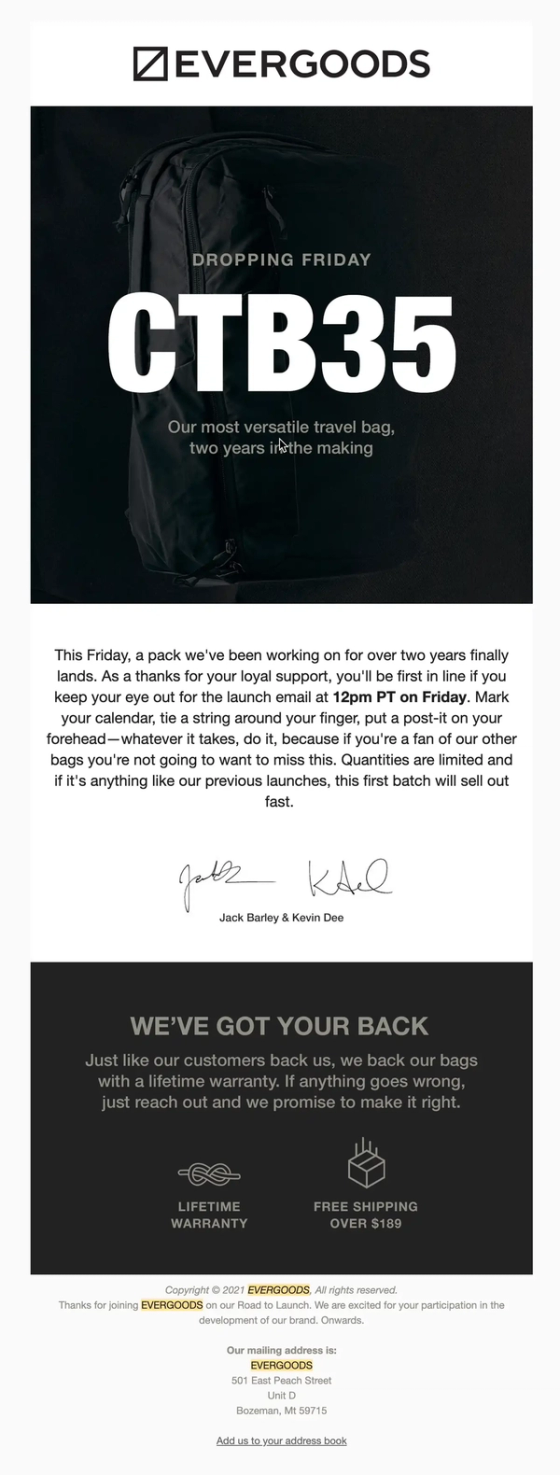
Evergoods announced its CTB35 travel bag with the message “Dropping Friday,” describing it as the brand’s most versatile travel bag, two years in the making.
Why it works: The two-year development story makes the release feel more significant than a routine product addition. Instead of revealing every feature upfront, Evergoods uses the work behind the product to create anticipation and gives customers a clear launch date to remember.
Product launch email tip: If a product has an interesting development story, make it part of your pre-launch campaign. Highlight what makes the upcoming release significant and give customers a specific date to look forward to.
Building anticipation
Patrick Ta Beauty
give customers early access to a new collection
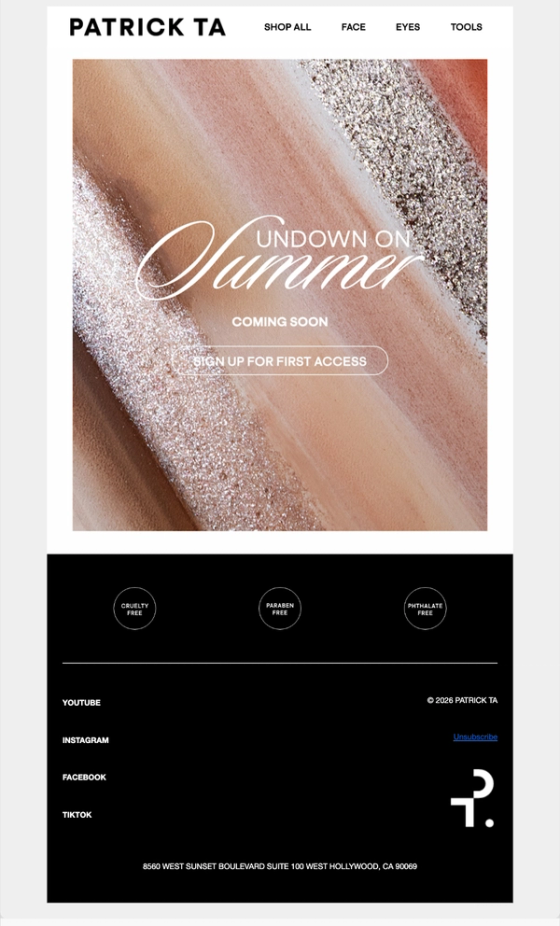
Patrick Ta Beauty introduced its Sundown on Summer collection with the subject line “New Season, New Collection” and a CTA inviting subscribers to “Sign Up For First Access.”
Why it works: Instead of asking customers to purchase something that isn’t available yet, Patrick Ta gives interested shoppers an opportunity to register for early access. The signup also helps the brand identify an audience already interested in the collection, making them a relevant segment for subsequent launch campaigns.
Product launch email tip: For upcoming launches, consider offering early access or a waitlist signup. You can use these signups to identify interested customers and send them relevant communications when the product becomes available.
Explaining value

Blueland
show customers how the product solves a familiar problem
Blueland introduced its cleaning tablets with messages including “Tiny Tablet, Big Clean” and “One Bottle, Refill Forever.” The email explains how customers can use cleaning tablets with reusable bottles instead of repeatedly buying conventional bottled cleaning products.
Why it works: Cleaning tablets may be unfamiliar to customers who normally buy bottled cleaning products. Blueland connects the new product to an existing household task, making it easy to understand how the refill system works and why customers might want to switch.
Product launch email tip: When introducing an unfamiliar product, explain how it changes something customers already do. Show what the product replaces, how it works and what practical benefit customers can expect.
Explaining value
Six Moon Designs
turn customer feedback into a product launch story
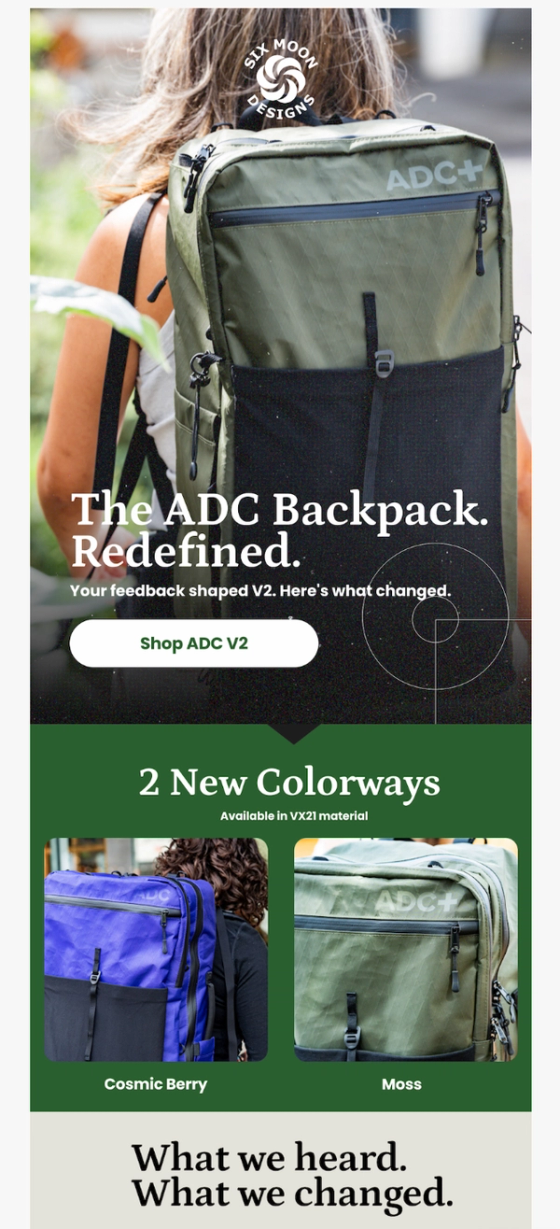
Six Moon Designs introduced its updated ADC V2 with the message “You asked. We listened.” The announcement highlights improvements customers had requested, including easier water bottle access, a better laptop fit and two new colorways.
Why it works: The launch gives existing customers a reason to reconsider the product by showing what has changed. Rather than announcing an updated version and listing its features, Six Moon Designs connects those improvements to customer requests.
Product launch email tip: When launching an improved version of an existing product, look at customer reviews, support tickets and product feedback to identify the most common complaints or requests. Use those improvements as the central message, and prioritize customers who previously purchased or showed interest in the original product.
Explaining value
Craighill
make product engineering the selling point
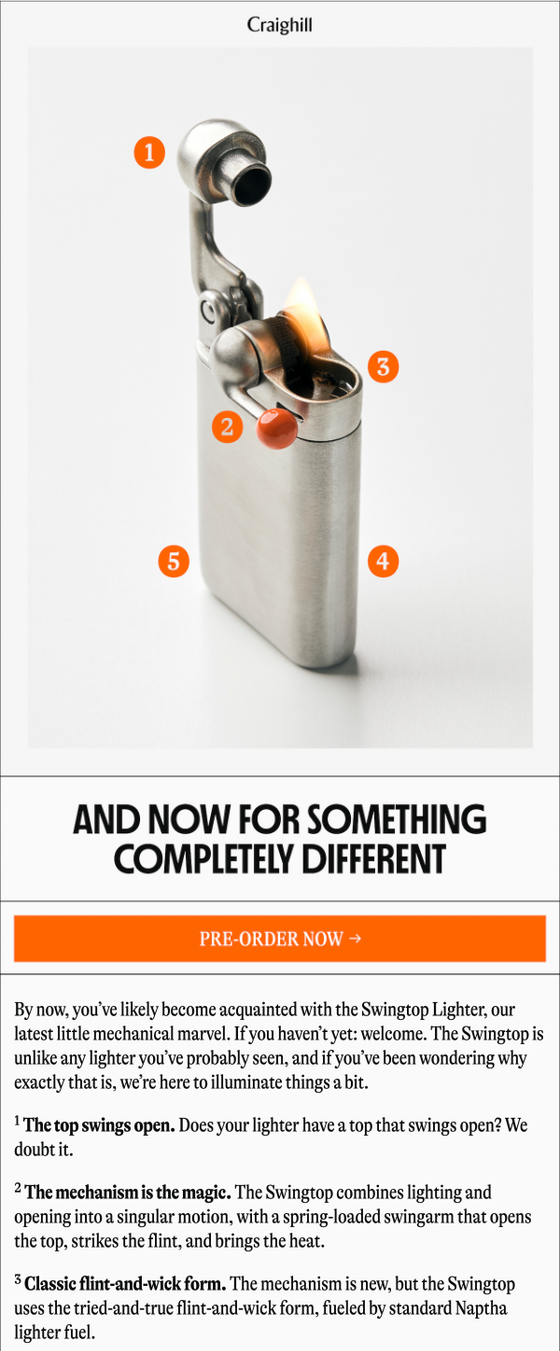
Craighill introduced its Swingtop Lighter through an email featuring an exploded product diagram, with numbered callouts explaining the lighter’s components and mechanism.
Why it works: A lighter is a familiar product, so simply announcing a new one doesn’t explain what makes it interesting. Craighill uses the product’s engineering to establish that difference, giving customers a closer look at its construction and the details that distinguish it from a conventional lighter.
Product launch email tip: If engineering or craftsmanship makes your product different, show customers those details. Product diagrams, close-up photographs or demonstrations can communicate features that ordinary product photography might miss.
New options
Mill
help customers choose between product models
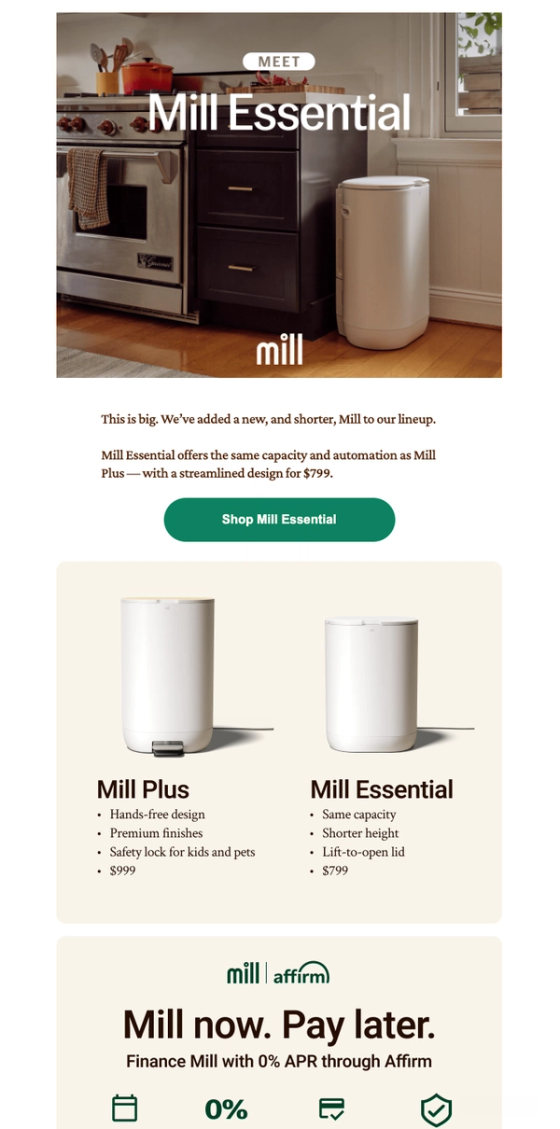
Mill announced its Essential food recycler with the subject line “Introducing Mill Essential.” The email compares the new model with Mill Plus, highlighting differences in features and pricing.
Why it works: Introducing another model gives customers an additional option, but also creates a decision they need to make. By comparing the two products, Mill helps shoppers understand which one suits their needs instead of leaving them to work out the differences themselves.
Product launch email tip: When launching a new version or model, compare it with existing products. Explain the meaningful differences in price, features and intended use so customers can choose the right option.
New options
West Elm
make a collaboration the reason to explore a new collection
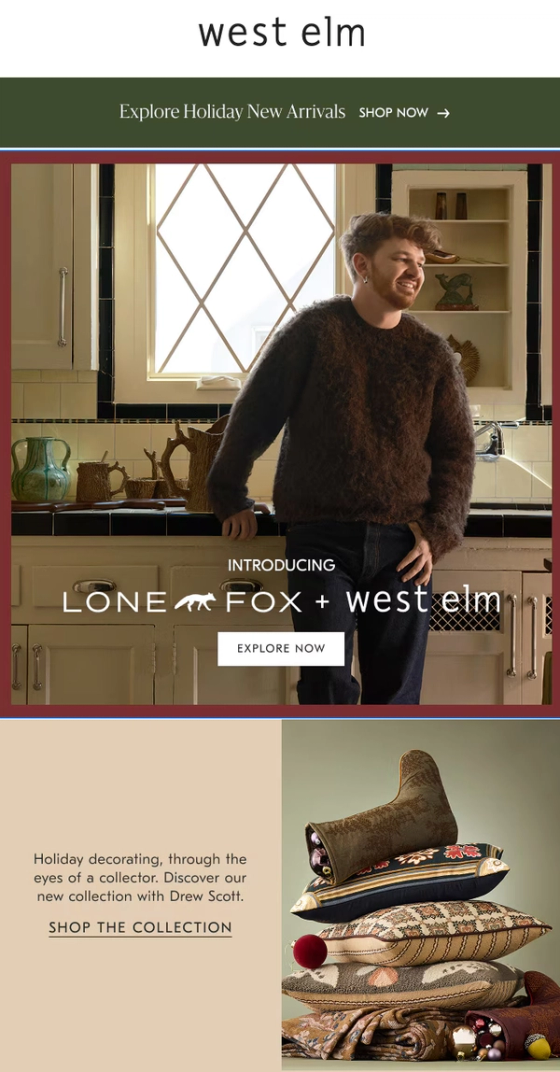
West Elm introduced its Lone Fox collaboration with Drew Scott through an email featuring furniture and decor arranged together in styled interiors.
Why it works: Rather than announcing several unrelated products, West Elm presents the collection through the aesthetic associated with Lone Fox. The collaboration gives the launch a recognizable identity, while the room photography helps customers visualize how different pieces work together.
Product launch email tip: For collaborations and collection launches, lead with the idea connecting the products. Explain what makes the partnership distinctive and show customers how the individual products work together.
Choosing the right approach for your product launch email
The right launch strategy depends on what customers need to understand before they’re ready to buy.
If you’re launching something your existing audience has been waiting for, a development story or early-access invitation can help build anticipation.
For a product whose value is not obvious from a photograph, the email has to carry the explanation. If it carries a premium price, give customers specific reasons to understand that positioning.
The marketing angle should determine what the product launch email says, not the other way around.
Once you know what makes the product worth paying attention to, it’s easier to decide what the email needs to include, how the product should be presented and what customers should do next.
For the planning that sits behind these campaigns — how big the launch needs to be, who receives it and in what order — read how to do product launch emails for ecommerce. For more creative worth borrowing, see Black Friday email design ideas.
Nexie is an AI-native ESP for e-commerce brands. It reads your customer data across engagement, recency, category interest and lifetime value together, surfaces the audiences worth campaigning to, and builds those campaigns for your team to review and approve, inside the guardrails and marketing policies you set. See how it works →